Field & Laboratory Geotechnical Solutions

Our Geotechnical Services

Standardized in-situ testing and accredited laboratory soil investigation procedures conforming to Bureau of Indian Standards (IS Codes) for safe foundation design.

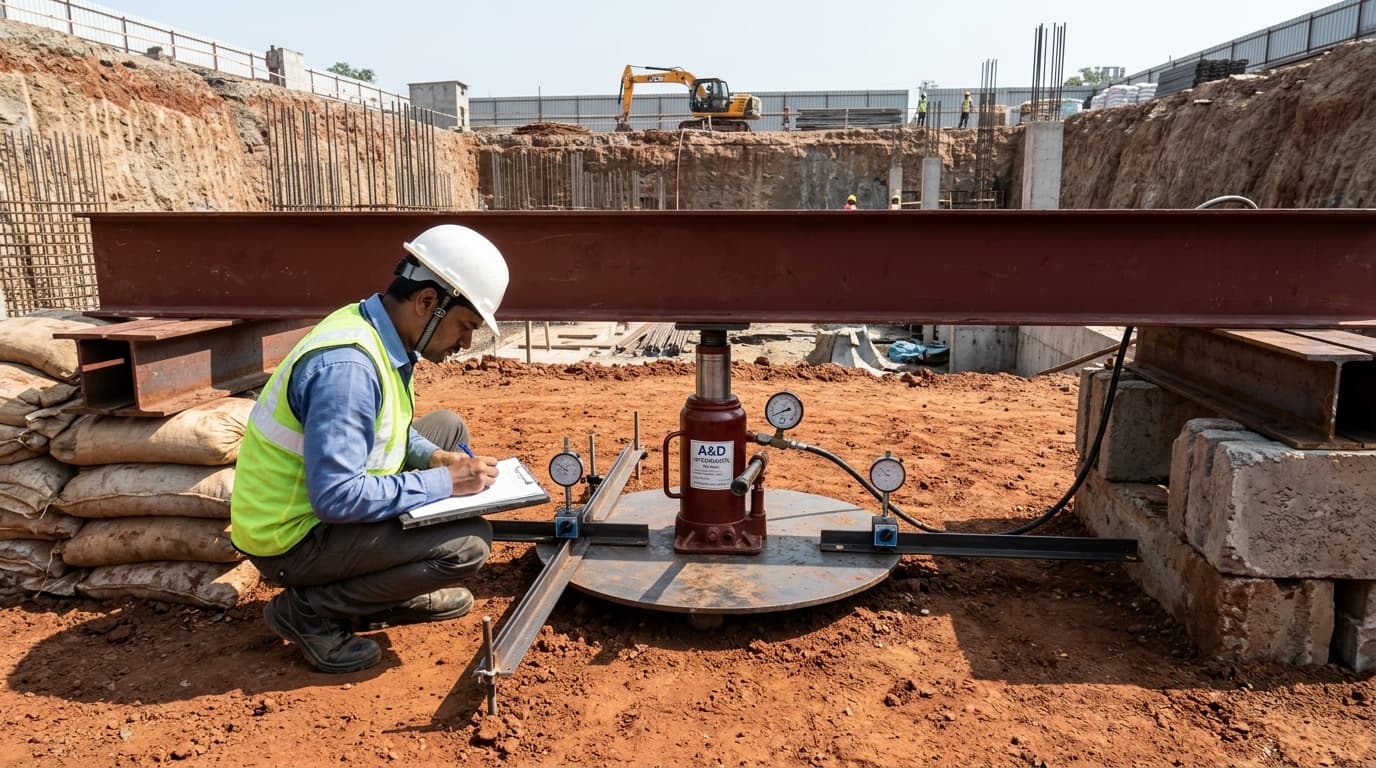
Soil Bearing Capacity Test - Geotechnical investigation by Shree Geotech

Technical Parameters

Reference Standard

IS 1888 / IS 6403

Plate Sizes

300mm, 450mm, 600mm & 750mm

Instrumentation

Calibrated hydraulic jack & dial gauges

Deliverable

SBC curve, settlement logs & technical report

Service #1

Soil Bearing Capacity Test

The Soil Bearing Capacity (SBC) test evaluates the maximum load per unit area that foundation soil or rock can support without experiencing shear failure or excessive structural settlement. Utilizing in-situ Plate Load Testing (PLT) in conformity with IS 1888 standards, Shree Geotech delivers conclusive geotechnical parameters directly utilized by structural engineers to size footings, rafts, and pile caps with confidence.

Purpose of the Test:

To identify the ultimate and safe bearing capacity of sub-surface strata, calculate anticipated elastic settlement, and prevent post-construction structural distress or differential settlement.

Testing Methodology & Steps:

  • Excavation of the test pit to proposed foundation founding depth.
  • Placement of precision-machined rigid steel bearing plate (300mm to 750mm diameter/square).
  • Assembly of heavy reaction frame and calibrated hydraulic loading jack.
  • Incremental load application with continuous settlement recording using dial gauges sensitive to 0.01mm.
  • Plotting load-settlement curves and calculating Safe Bearing Capacity applying relevant safety factors.

Key Applications:

  • •Isolated and combined footing design for residential buildings
  • •Industrial equipment machine foundation pads
  • •Commercial high-rise podium and tower foundation layouts

Client Value:

  • ✓Eliminates foundation over-design and saves concrete and steel costs
  • ✓Provides empirical site data required for municipal and structural compliance
  • ✓Prevents structural cracking and foundation tilt over long-term lifecycle
Soil Boring Test - Geotechnical investigation by Shree Geotech

Technical Parameters

Reference Standard

IS 1892 / IS 2131

Borehole Diameter

75mm to 150mm NX/BX size

Depth Capability

Up to 30m - 50m+ depending on strata

Core Preservation

Heavy-duty wooden core boxes with depth markers

Service #2

Soil Boring Test

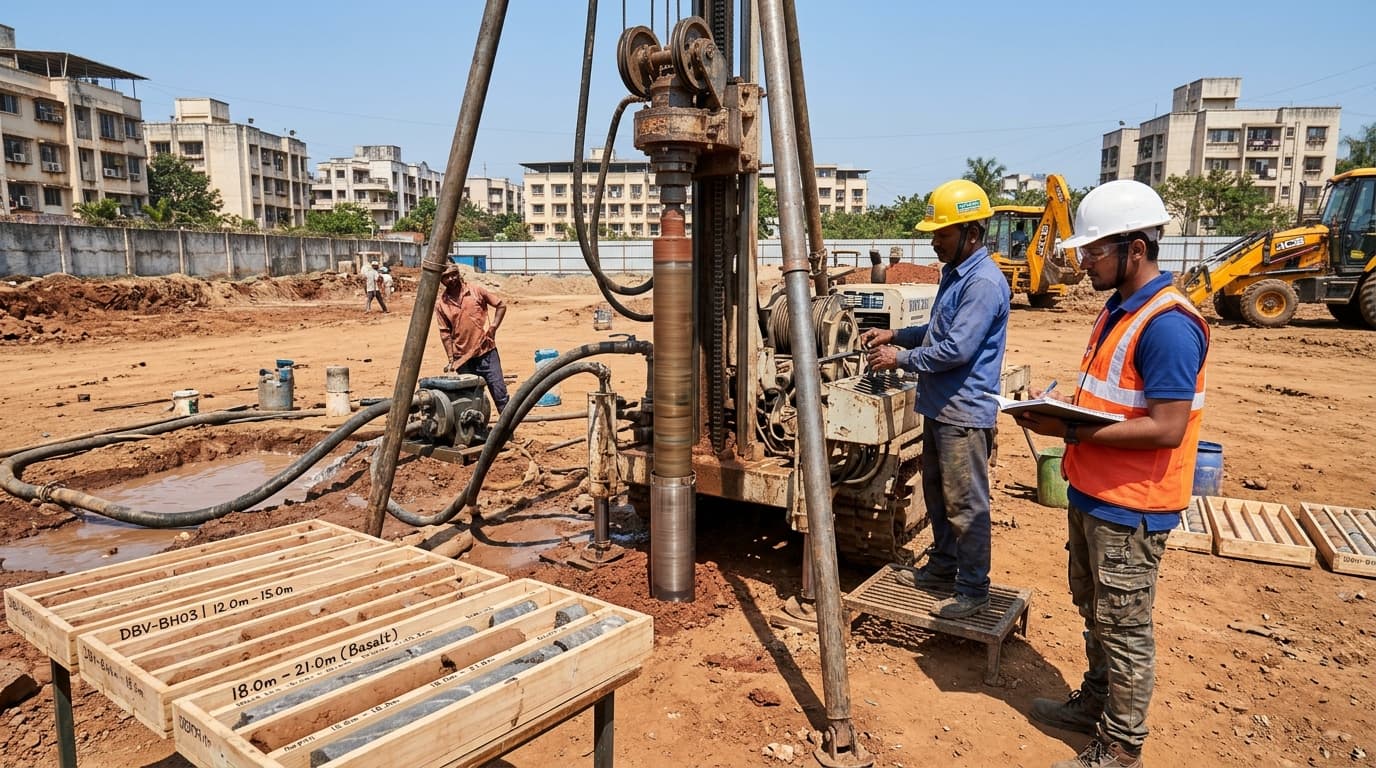
Exploratory soil boring is the cornerstone of geotechnical subsurface investigation. Utilizing hydraulic rotary drilling rigs, calyx setups, and auger drilling systems, Shree Geotech drills deep exploratory boreholes across diverse geological strata of the Mumbai Metropolitan Region—from marine clay and murrum to hard weathered basalt rock. Undisturbed (UDS) and disturbed soil samples are systematically collected alongside rock core barrels for comprehensive laboratory analysis.

Purpose of the Test:

To map the continuous subsurface stratigraphy, determine strata thickness, locate groundwater table elevation, and extract representative samples from target foundation depths.

Testing Methodology & Steps:

  • Setting up rotary drilling tripod or hydraulic crawler rig at predetermined grid coordinates.
  • Advance borehole drilling through overburden soil using wash boring or hollow stem augering.
  • Diamond core drilling through hard rock formations using double-tube core barrels.
  • Systematic recovery of rock cores, logging Rock Quality Designation (RQD) and Core Recovery (CR).
  • Recording static groundwater levels following equilibrium stabilization.
  • Preserving samples in airtight wax-sealed tubes and labeled core boxes for laboratory transfer.

Key Applications:

  • •Multi-storey residential towers and high-rise developments
  • •Flyover, metro, and elevated roadway pier foundations
  • •Deep basements, retaining shoring systems, and diaphragm walls

Client Value:

  • ✓Identifies weak soil layers, fissures, and cavernous zones before excavation
  • ✓Provides exact depth of refusal to sound bedrock for pile founding
  • ✓Accurate groundwater level mapping prevents dewatering failures during construction
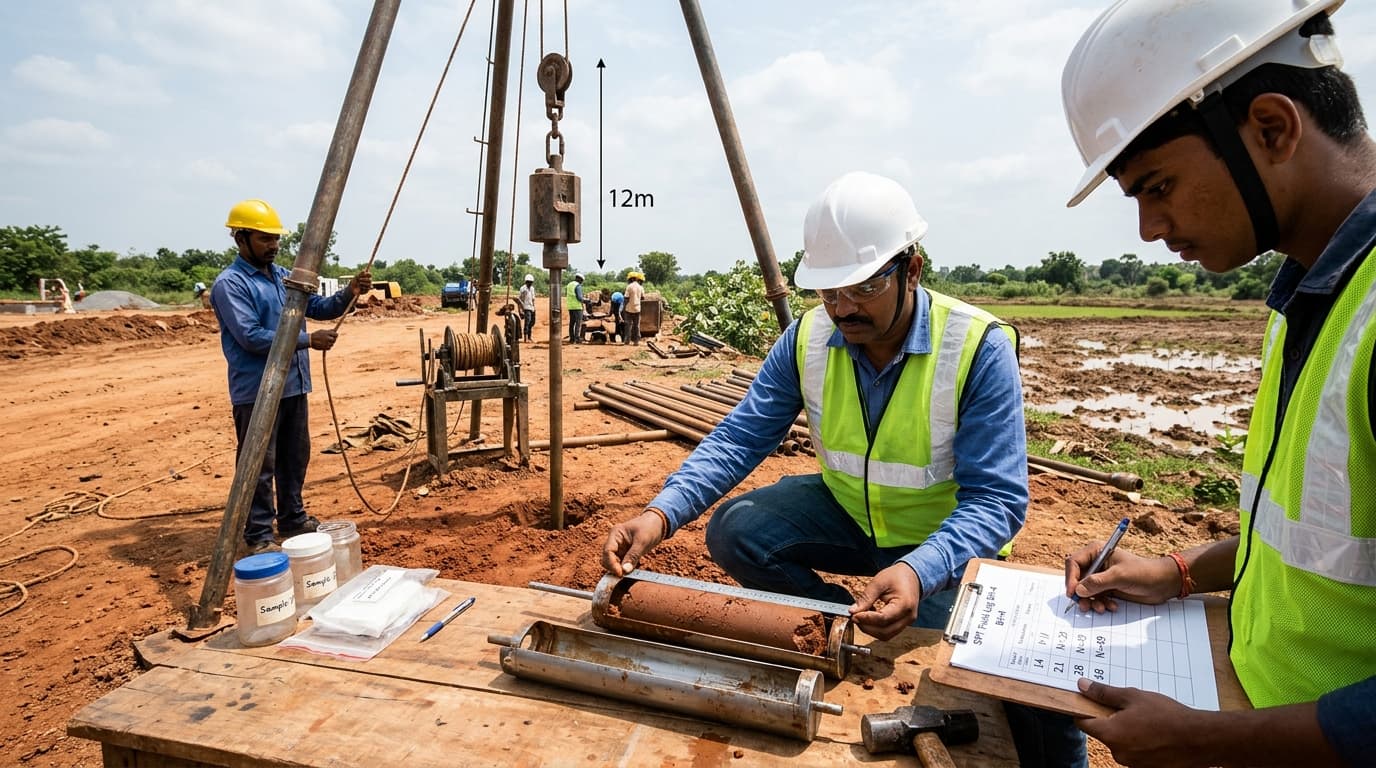
Standard Penetration Test (SPT) - Geotechnical investigation by Shree Geotech

Technical Parameters

Reference Standard

IS 2131:1981 (Reaffirmed)

Hammer Weight

63.5 kg with free-fall drop of 750 mm

Sampler Specs

Standard split-spoon sampler (50.8mm OD, 35mm ID)

Corrections Applied

Overburden pressure (IS 2131) and dilatancy

Service #3

Standard Penetration Test (SPT)

The Standard Penetration Test (SPT) is one of the most widely specified in-situ geotechnical tests globally. Conducted at regular borehole depth intervals (typically every 1.5m or at strata change), a standard split-spoon sampler is driven into the bottom of the borehole by an automatic 63.5 kg drop hammer falling freely from a height of 750 mm. The measured N-value provides direct empirical correlations to soil cohesion, friction angle, and liquefaction susceptibility.

Purpose of the Test:

To quantify the in-situ relative density of cohesionless soils and the consistency of cohesive clays, while recovering representative soil specimens for classification.

Testing Methodology & Steps:

  • Cleaning borehole bottom to sound strata at designated test depth.
  • Lowering the split-spoon sampler attached to drill rods to the bottom.
  • Seating drive: applying initial 150 mm penetration blows to seat the sampler.
  • Test drive: applying hammer blows for the subsequent two 150 mm penetration increments (total 300 mm).
  • Summing the blow counts for the last 300 mm to calculate the observed field SPT N-value.
  • Applying standard corrections: overburden pressure correction (CN) and dilatancy correction (N').
  • Extracting disturbed sample from the split spoon for field visual identification.

Key Applications:

  • •Determination of soil internal friction angle (φ) and undrained cohesion (cu)
  • •Assessment of soil liquefaction potential in earthquake-prone zones
  • •Direct estimation of allowable bearing capacity for shallow and deep pile foundations

Client Value:

  • ✓Internationally standardized, robust, and cost-effective in-situ metric
  • ✓Continuous profiling throughout borehole depth delivers comprehensive site characterization
  • ✓Essential baseline data mandated by municipal development authorities and structural consultants
Chemical Analysis of Soil - Geotechnical investigation by Shree Geotech

Technical Parameters

Reference Standard

IS 2720 (Part 26, Part 27) & IS 456

Parameters Analyzed

pH value, Sulfates (SO4), Chlorides (Cl), Organic matter

Sample Source

Subsoil core samples and groundwater seepage

Laboratory Facility

Controlled civil chemical testing equipment

Service #4

Chemical Analysis of Soil

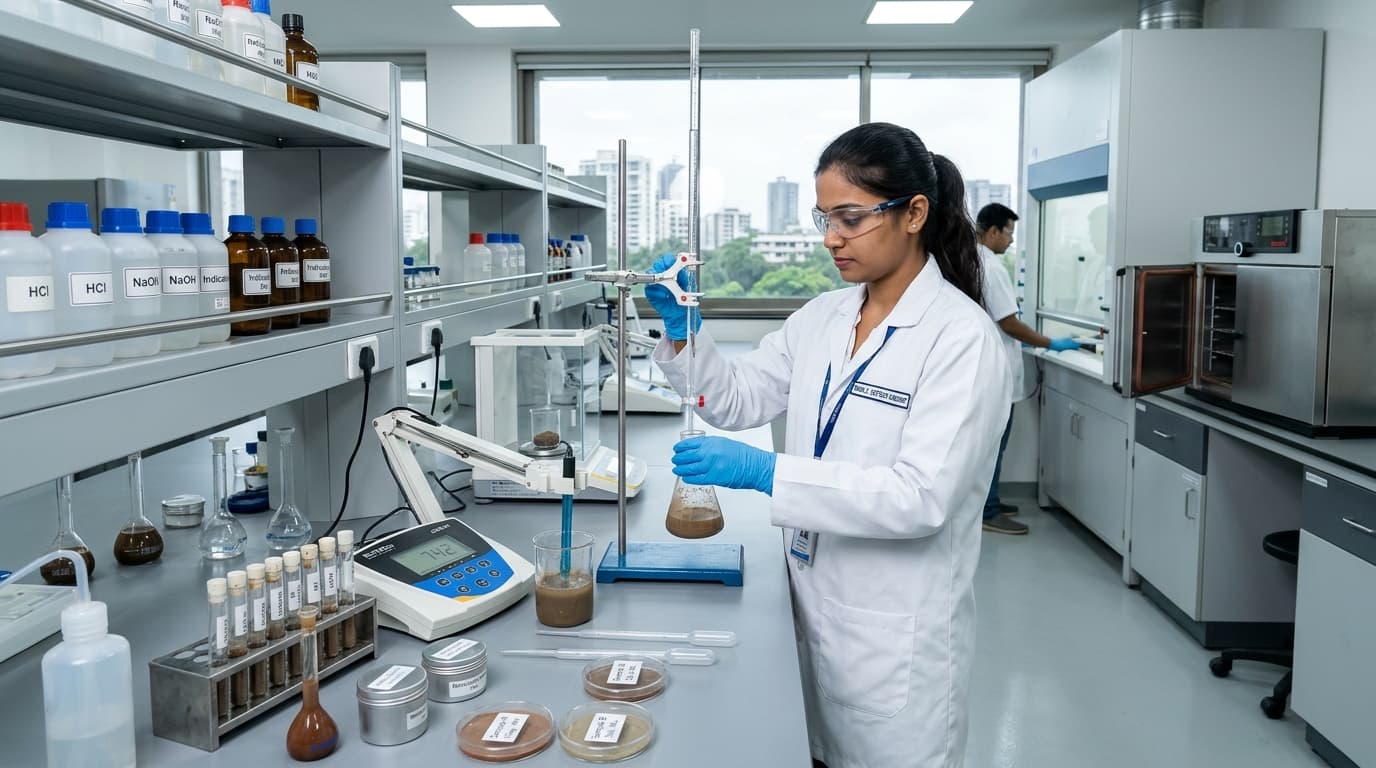
Aggressive chemical compounds in subsurface soils and groundwater can severely compromise the long-term durability of subterranean concrete and steel rebar. Shree Geotech conducts rigorous laboratory chemical profiling on soil extracts and water samples. We evaluate soil pH, water-soluble sulfates (SO3/SO4), chlorides (Cl), and organic content in accordance with IS standards to prescribe the required concrete grade, water-cement ratios, and sulfate-resistant cement requirements.

Purpose of the Test:

To detect aggressive corrosive agents in subsoil that could attack buried reinforced concrete structures, cause rebar pitting, and lead to premature structural degradation.

Testing Methodology & Steps:

  • Collection and preservation of soil samples from distinct strata depths.
  • Preparation of standard 1:2 or 1:5 soil-water aqueous extract solutions.
  • Potentiometric measurement of soil pH using calibrated laboratory electrodes.
  • Gravimetric or spectrophotometric quantification of soluble sulfates (as SO3 / SO4).
  • Argentometric titration testing for soluble chloride concentration.
  • Determination of organic matter content through loss on ignition or chemical oxidation.
  • Classification of exposure condition as per IS 456 (Mild, Moderate, Severe, Very Severe, Extreme).

Key Applications:

  • •Specification of foundation concrete mix design (IS 456 Table 4 compliance)
  • •Selection of sulfate-resisting Portland cement (SRC) vs ordinary Portland cement (OPC)
  • •Subsurface corrosion protection design for steel piles and sheet piling

Client Value:

  • ✓Protects foundation assets from expensive hidden corrosion and concrete spalling
  • ✓Ensures compliance with national building codes and environmental norms
  • ✓Enables structural consultants to select optimal concrete protection without wasteful over-spec
Technical Inquiries

Service Related FAQs

Require a Customized Soil Testing Proposal?

Share your plot dimensions, structural requirements, and location for a detailed engineering quotation.

WhatsApp - Shree Geotech